
Woods County Projected Versus Actual Release
“Projected Release Date,” often shortened to PRD, is the Oklahoma Department of Corrections term for an estimated prison release date. The Oklahoma Pardon and Parole Board says ODOC calculates it and that good-behavior credits, programs, or misconduct can make it rise or fall. ODOC’s own public guidance also calls a release date tentative. An actual release is a completed custody event shown by a released or discharged status and, when needed, an agency discharge record.
County custody works differently. A person awaiting trial at Woods County Jail has no sentence-based PRD. Bond, dismissal, a release order, another hold, or later sentencing controls what happens. A person serving a county-only term needs the Woods judgment, credited jail time, and sheriff’s actual discharge record. ODOC’s prison credit system should not be pasted onto a county-only sentence.
A roster disappearance is also not an actual release date. It may signal transfer to ODOC, another jail, ICE, or another custodian. Ask two questions: when did Woods County custody end, and what agency or supervision status followed?
Find Woods County Projected Release Dates
Start by identifying the sentence and custody system. For a person sentenced to ODOC or held at Charles E. “Bill” Johnson Correctional Center, search the ODOC Offender Lookup. Search by exact or partial name, and use the ODOC number when known. Compare the sentence court, conviction data, identifiers, photo, facility or supervision relationship, and exact status before using any displayed date.
- Obtain the judgment, case number, sentence terms, and any jail-time credit.
- Decide whether the case is county-only, an ODOC sentence, or a federal or immigration matter.
- For ODOC, open plausible lookup matches and verify the correct person.
- Read the live field exactly as labeled, including “projected” or “tentative.”
- Check the Woods or sentencing-county docket for amended judgments, revocations, or other orders.
- For a formal answer, ask the proper jail records unit or ODOC Sentence Administration for releasable records.
ODOC’s published sources contain a real access tension. One policy directs readers to Offender Lookup for offense, projected release date, and photo. Its current FAQ says release date information is confidential without a legitimate need and describes the date as tentative. The safe practice is to report only the field that is visible in the live record. Never promise that every person will have a public exact date.
For Woods County Jail, call 580-327-3434 and request an existing jail-register entry, release sheet, and release or transfer instrument. For a court result, search OSCN and ODCR, then ask the Woods County Court Clerk for a certified final disposition when needed. The Woods County release-record workflow explains how those local sources pair with ODOC.
Woods County Earned-Credit Rules
Oklahoma’s state-prison earned-credit framework appears in 57 O.S. §138. One earned credit equals one day. Class 1 earns no monthly class credit, while Class 2 earns 22. Class 3 and Class 4 rates depend on specified prior enumerated felony history: 33 and 44 with that history, or 45 and 60 without it. Advancement requires time and evaluations. Classification can later change.
Credits are not guaranteed future days. They can be removed through the required discipline process, and restoration is discretionary. Program and achievement credits have their own conditions. Section 138.1 also allows up to 100 meritorious-act credits under its limits. ODOC’s public PRD applies its current record of sentence terms and credits more reliably than outside arithmetic, yet the result remains tentative.
These are ODOC rules. They do not automatically calculate the end date for a Woods county-only detainee. If a sentenced person is still physically at the county jail while awaiting ODOC reception, that location does not convert the state sentence into a local formula. Use the judgment, court-awarded jail credit, ODOC record, and later discharge evidence.
- Earned credit
- A sentence credit awarded under state law and ODOC classification or program rules.
- Jail-time credit
- Time the judgment recognizes as already served before or during sentencing.
- Concurrent sentence
- Terms set to run at the same time.
- Consecutive sentence
- Terms set to run one after another.
- Detainer
- A request or hold tied to another agency or pending custody matter.
No Woods County Date Calculator
Oklahoma’s Class 3 and Class 4 credit rates change according to the specified prior-history rule. Misconduct, achievements, court amendments, jail credit, and holds can then move the PRD. A simple sentence-minus-days calculator cannot reproduce that live agency record. Publishing a homemade date would hide the assumptions and could turn an eligibility point into a false release promise.
Begin with all controlling cases. Determine whether terms are concurrent or consecutive and what jail-time credit the court awarded. Check the offense date and the version of each governing statute. Apply ODOC’s sentence administration only to an ODOC sentence. Then account for later orders, disciplinary action, achievements, parole action, and holds. The result of that work is still an estimate until the agency records an actual event.
Note: A past projected date does not prove release; check the current status and ask for discharge confirmation when the outcome matters.
Woods County Parole Eligibility Limits
21 O.S. §13.1 requires a person convicted of an enumerated offense under the applicable version to serve at least 85 percent before parole consideration. Credits cannot reduce actual service beneath that statutory floor. The offense list and effective version have changed. Check both the offense and its date. The rule is not universal for every offense described as violent.
Eighty-five percent is not a release promise. It is a minimum service rule before parole consideration in the covered cases. It does not compel the Board to grant parole. In the same way, an offense outside §13.1 does not guarantee release at one-third of a sentence. A fraction in 57 O.S. §332.7 may mark eligibility for consideration under a date-specific rule.
Section 332.7 itself is date-sensitive. Older offenses may use one-third or matrix alternatives, while many offenses from July 1998 through October 2018 use a one-third framework. Later classifications and exclusions must be checked in the current law. Life without parole and death sentences are ineligible. A PPB investigator, not a public calculator, evaluates the offense, date, sentence, and jail credit for parole review.
Why Woods County Release Dates Move
A projected date changes when the facts inside the calculation change. Some changes credit time. Others add a hold, remove a credit, alter the controlling judgment, or replace one expected outcome with another. A future date should therefore be saved with the date it was checked and rechecked near the event.
| Factor | Possible effect |
|---|---|
| Corrected jail-time credit | Changes the amount of time already recognized |
| Concurrent or consecutive clarification | Changes how multiple terms combine |
| Amended judgment or court relief | Changes the controlling sentence record |
| Class or achievement credits | Can move the estimate under ODOC rules |
| Misconduct or credit loss | Can move the date later |
| Parole action | Changes eligibility or release processing, not always the sentence end |
| Detainer, hold, or new sentence | May prevent community release or start another custody episode |
| Recalculation | Updates an earlier estimate when agency data changes |
ODOC’s status-change vocabulary includes discharge, parole, rebill, death, court modification, extra jail time, new sentence, detainer, and release to ICE. Not every item is promised as a public live field. Ask Sentence Administration for the releasable part of the actual record, while respecting confidential health, safety, and supervision details.
BJCC Woods County Release Outcomes
Charles E. “Bill” Johnson Correctional Center is a state minimum-security ODOC program prison in Alva, not a county jail. Its population includes people in different legal pathways. Some serve conventional state sentences. Others may participate in regimented treatment, delayed sentencing, or an Intermediate Revocation Program. The pathway must be identified before a departure can be called release or discharge.
Delayed-sentencing completion may produce dismissal, deferment, or probation according to the filed court outcome. An intermediate revocation participant may return to supervision while the underlying sentence remains active. For a conventional state sentence, ODOC status and discharge records control, with parole records added when relevant. A program completion notice alone does not prove the legal result.
This Woods County feature is why facility location and legal custody must remain separate. A person leaving BJCC may not live or report in Woods County. Pair the ODOC event with the sentencing-county order and assigned probation or parole office. Do not infer an exit time, transport plan, property process, or supervision location from the facility’s general fact sheet.
Review Woods County Date Records
ODOC publishes forms for review and challenge when an individual record appears wrong. Its Section 06 forms page includes forms 060212B, C, D, and F for review, challenge, individual record access, and authorization. DOC 060901B is a Release Checkout Sheet. Select the process that matches the requester and issue rather than sending a broad demand.
The official forms page shown below is the one successful projected-date screenshot in the manifest. It supports record review and correction, not a promise that the agency will publish a precise date for every person.
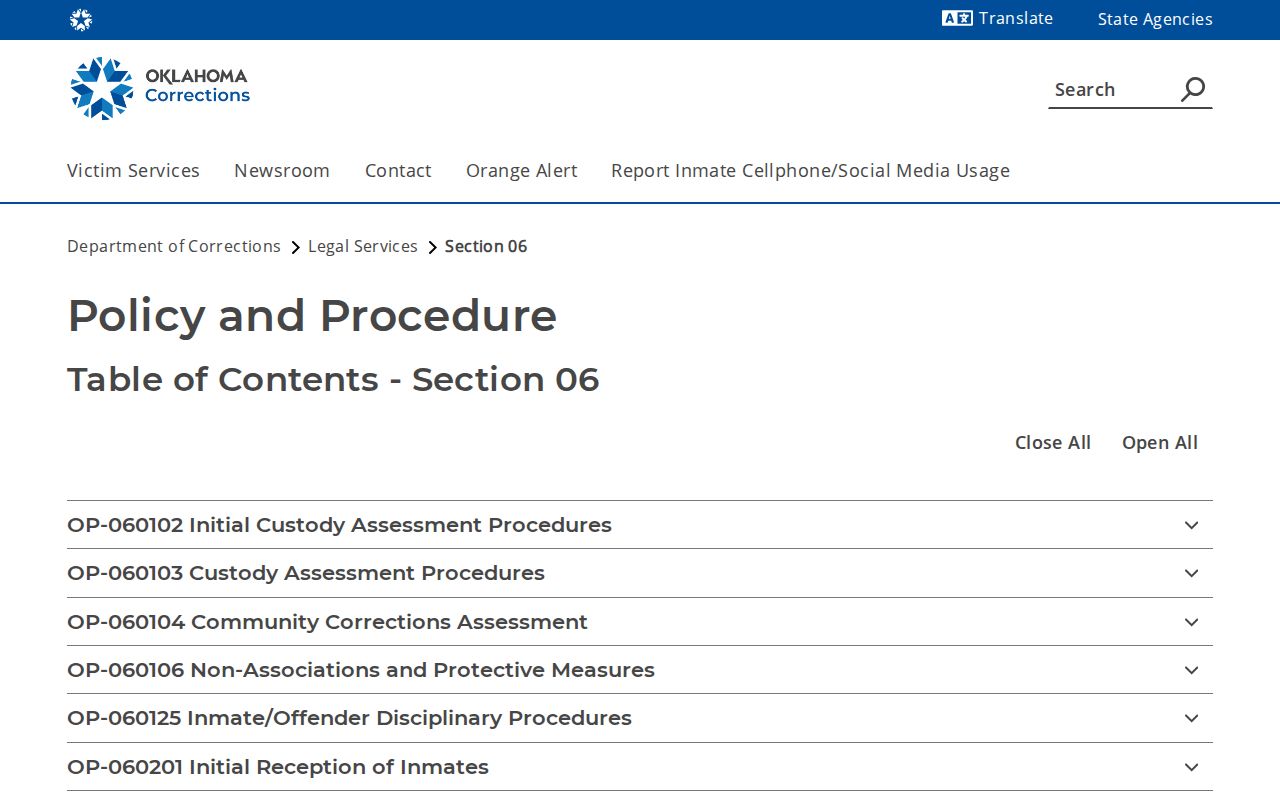
ODOC Legal Services lists Closed Records at 405-425-2691, osor@doc.ok.gov for inquiries, and osordischarges@doc.ok.gov for discharges. Ask for an existing releasable record. A wrong court judgment or docket entry must instead be addressed through the court clerk and the proper correction process.
Confirm Woods County Actual Release
Near an expected date, recheck the live ODOC status and the latest court orders. If the record shows parole or probation, confinement may have ended while supervision continues. If it shows a facility change, that is a transfer. A discharge label may support the end of ODOC custody or supervision, but formal needs may call for the agency’s discharge record.
OK VINE can provide a pending custody-change alert for participating county and ODOC systems. The Woods County VINELink release check explains the one-person search and four-digit telephone PIN. VINE is still not certified proof, and it does not cover BOP or ICE. Confirm a reported event with the agency that supplied it.
For Woods County Jail, use the statutory register’s date or manner of discharge and the release or transfer instrument. Add the court order for legal authority. The most accurate statement names the system and event: Woods custody ended, ODOC discharged the state sentence, or a person moved to supervised release. Avoid a claim of complete freedom unless all relevant holds and transfers have been resolved.